F-1 High School Programs: How Studying in the USA Works
How F-1 high school programs in the USA actually work — public vs. private rules, the I-20, program length, English, costs, sports, and how to choose.
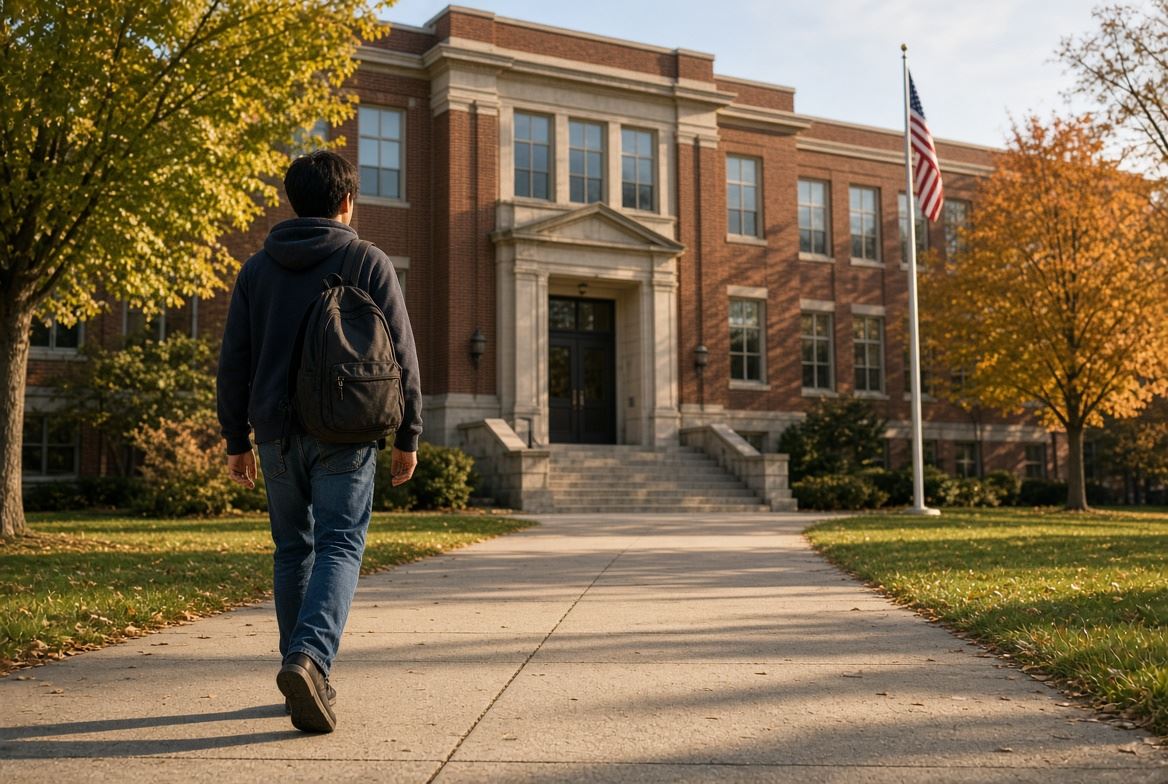
Every year, students from around the world enroll at American high schools on the F-1 student visa — the U.S. visa for full-time academic study. It is the route most families use for anything longer than a single exchange year, and it works differently from what many people expect: differently at public schools than private ones, differently at boarding schools than day schools, and differently from the J-1 exchange program it is often confused with.
This is the plain-English guide to how F-1 high school programs actually work — what the federal rules fix in place, and what each school decides for itself.
It starts with one certification: SEVP and the I-20
Not every American school can enroll an international student. A school must first be certified by the Student and Exchange Visitor Program (SEVP) — it petitions the Department of Homeland Security on Form I-17, and once approved, its designated school official (DSO) can issue the Form I-20, the document every F-1 visa application is built on.
The sequence for a student looks like this:
- Apply to an SEVP-certified school and be accepted.
- The school issues your Form I-20.
- Pay the I-901 SEVIS fee — currently $350 — and keep the receipt.
- Interview for the F-1 visa at a U.S. embassy or consulate, I-20 in hand.
- Show your documents again at the port of entry, then report to the school on your I-20.
Everything else in this article — housing, sports, graduation — varies school by school. This part doesn't. No SEVP certification, no I-20, no visa. It's the first thing to check about any school, and it's why every school on the XportEdu marketplace is F-1-ready by definition.
Public vs. private: the rule that shapes everything
The single biggest fork in the F-1 road is whether the school is public or private, because federal law treats them very differently:
| Public schools | Private schools | |
|---|---|---|
| Grades open to F-1 | 9–12 only | K–12, if certified for those grades |
| Time limit | 12 months total | None — multi-year enrollment |
| Cost rule | Must pay the district's full, unsubsidized per-capita cost, with proof of payment | Tuition as the school sets it |
| Typical use | A one-year American experience | Multi-year study, diploma track |
The details behind that table: an F-1 student at a public high school may attend for a maximum aggregate of 12 months, must reimburse the district the full cost of their education, and must show proof of that payment at the visa interview and again at the border. Public elementary and middle schools cannot enroll F-1 students at all. Private schools carry none of those restrictions — a certified private school can enroll an F-1 student from kindergarten through twelfth grade, for as many years as it takes.
The practical consequence: a multi-year F-1 program is, structurally, a private-school program. A public school year is a real and often wonderful option — but it is one year, by law, and it also rarely ends in a U.S. diploma, because twelve months usually isn't enough time to complete one school's graduation requirements. The public-school route has enough rules of its own that we've given it a separate article — including the twelve-month aggregate, the reimbursement requirement, and the penalty for getting it wrong.
How long an F-1 program lasts
Federal rules cap exactly one thing here — the twelve months at a public school — and leave the rest to each school's own program design. In practice, F-1 high school programs come in four shapes:
- A semester. Fall runs from August or early September to the winter break in December. Spring runs from January to late May or early June. Not every school admits mid-year, so a spring start narrows the list before you've chosen anything else.
- An academic year. The most common choice, and the one the rest of American high school is built around — you arrive for the start of the fall term and leave when the year ends, having seen a full cycle of sports seasons, holidays, and school traditions.
- Multiple years. Private schools only, and the standard route if a U.S. diploma is the goal. Students commonly arrive for tenth or eleventh grade and stay through graduation.
- Short term. Anywhere from a couple of weeks to a few months. A real and growing option for families who want the experience without committing to a year — though short-term programs rarely include a full sports season and never end in a diploma.
One variation worth knowing if you're in the southern hemisphere: some students run January to December, spanning two U.S. school years, to stay closer to a home-country calendar that runs the other way round. Schools differ on whether they'll accommodate it, so ask early rather than assuming.
Which grades, and how you get placed in one
Public schools can enroll F-1 students in grades 9 through 12 only — public elementary and middle schools cannot enroll F-1 students at all. Private schools can be certified for whatever grades they teach, kindergarten upward, so study below ninth grade on an F-1 visa is a private-school proposition by definition.
Which grade you actually land in is the school's decision, not the government's. Admissions weighs your transcript, your age, and its own placement policy — and the answer isn't always the grade you'd be in at home. Curricula don't line up neatly across countries. A school may place a student a year below their home-country grade to build a stronger foundation, or accept enough transferred credit to put them further ahead than the family expected.
F-1 also has no federal age window, which is a genuine difference from J-1 exchange. On F-1 the limits belong to the school: each one sets its own minimum age and the youngest grade it will take an international student into.
If a diploma is the goal, ask two questions in the same breath: what grade will you place my child in, and how many of their existing credits will you accept? Those two answers together are what tell you how many years this will actually take.
When the American school year actually starts
There is no national school calendar in the United States. Every district and every private school sets its own, and the spread is wider than most families expect.
The broad pattern: the fall term opens somewhere between late July and mid-September, and the year ends between mid-May and late June. Schools in southern states tend to start earliest and finish earliest; northern schools start later and run later, partly because they build in days they expect to lose to snow. A winter break splits the year around late December, and most schools take a spring break of a week or so.
This matters more than it sounds, because everything upstream is scheduled backwards from that first day — the application, the acceptance, the I-20, the visa interview, the flight. Consulate appointment waits vary by country and by season, and the months before a fall start are the busiest of the year. Families who begin a full year ahead of the intended start date aren't being excessive. They're being comfortable.
Never assume a date. Confirm the exact first day of term with the specific school before anyone books anything.
Day school or boarding school — and where you'll live
SEVP certifies the school, not the housing. Where an F-1 student lives is decided by the school's own program design, and it takes a few common shapes:
- Boarding schools house students on campus — dorms, meals, and supervision are part of the program. This is the most self-contained option, and the one where housing questions mostly answer themselves.
- Day schools with their own homestay program — the school recruits, screens, and manages host families directly, and homestay is often part of one package price.
- Day schools that work with a homestay company or receiving organization — a third party (the receiving organization) holds the host family network, places the student, and provides the local coordinator who supports everyone during the year.
- Living with relatives or family friends — because F-1 housing isn't federally standardized, some families arrange for the student to live with people they already know. Schools may still have their own approval requirements for this, so ask.
The question worth asking any day-school program: who screens the host family, and who do we call when something comes up in February? Federal rules don't standardize F-1 homestay oversight — the school's or organization's own standard is the standard — so the quality of that answer tells you a lot. (Thinking about the other side of that equation? Here's how hosting works.)
You pick the school
Here is the part of F-1 that families coming from the exchange world often don't realize:
On an F-1 visa, the student chooses the school — not the other way around.
On the classic J-1 exchange, a sponsor organization places the student, typically without the family choosing the school or the town. The F-1 route runs the opposite direction: you find the school that fits — the AP courses, the swim team, the size, the state, the budget — apply to that school, and its acceptance is what produces your I-20. F-1 also has no federal age window the way J-1 does; grade placement is the school's own decision, based on your transcript and age.
That flexibility is the whole reason a searchable school marketplace makes sense for this visa: the more schools you can actually see, the better the fit you can choose.
English: no federal test, a hundred school policies
There is no federal English requirement for an F-1 visa. No minimum score appears in the regulations and no particular test is mandated. What exists instead is every school's own admissions bar — which is precisely why this question produces such contradictory answers online, and why any confident single answer you read is wrong.
Most schools do assess English somehow. The common approaches: a standardized test built for the secondary-school context — the ELTiS is widely used for this — a general English proficiency test, a live interview over video, or some combination. Some schools want a score before they'll read the application. Others interview first and test later. A few rely on the conversation alone.
What matters is understanding what a lower English level actually changes. It changes which schools are realistic — not whether studying in the U.S. is possible. Schools with established ESL or ELL programs are built for students who arrive still developing their English, and boarding schools often carry the most support of all, because the teaching staff and the residential staff belong to the same community and the help doesn't stop at 3pm. Schools without that infrastructure tend to set a higher bar, for the honest reason that they have no way to catch a student who can't follow a lecture.
So treat your current level as a filter, not a verdict. Then ask every school on your list two things: what do you require, and what support do you have for students who are still getting there?
Graduation, diplomas, and the PG year
Federal rules don't decide who graduates — each school's own credit and residency requirements do. So policies genuinely vary:
- Multi-year students at private schools commonly earn a U.S. high school diploma — that's the standard diploma track.
- One-year students usually can't, simply because one year rarely satisfies a school's graduation requirements — though some schools will place a student with strong transferable credits directly into a senior year that ends in a diploma.
- Some schools don't offer a diploma track to international students at all, treating the program as a year of study instead. Neither policy is right or wrong — but you want to know which one you're signing up for before you commit.
- A number of private prep schools also offer a postgraduate (PG) year — an extra year after high school graduation, often used to strengthen academics or athletics before university.
If a diploma matters to your plans, make it one of your first questions — and ask how many of your home-country credits the school will accept.
Sports: ask before you commit
There is no single national rule for whether an international student can play. Eligibility comes from each state's high school athletic association and the league a school competes in — and those rules differ. Some allow international students full varsity participation; some limit transfer students or visa students to junior varsity or a single year of varsity; some leagues have no restrictions at all. Private school leagues often run by their own rulebooks.
None of this is a reason to give up on playing — thousands of international students compete every season. It is a reason to ask the athletic director exactly what applies at that school before you choose it, especially if a roster spot is the point. Searching by sport narrows the field; the school's own answer settles it.
Religious and secular private schools
A large share of American private schools are religiously affiliated — Catholic, Protestant, and others — and most enroll students of any faith or none. What varies is daily life: some expect attendance at chapel or a religion class; others carry the affiliation lightly. Plenty of private schools are fully secular, too. Ask what's expected day to day, and treat the answer as part of the fit — like class size or the sports program, not a surprise for the first week.
What it costs — and who charges for what
F-1 prices vary more than almost anything else in this article, because an F-1 "program price" isn't one thing. It's a stack of separate services, and the single most useful habit a family can build is learning to see the stack instead of the total.
A full-year price is usually assembled from some combination of:
- Tuition — what the school charges to educate your child. At a public school this isn't a market price at all: federal rules require the F-1 student to reimburse the district the full, unsubsidized per-capita cost of that education, with proof of payment shown at the visa interview and again at the border.
- Housing and meals — room and board at a boarding school; a homestay placement fee and a monthly host family stipend at a day school.
- Placement and program services — finding and screening the host family, matching the student, and running the program through the year. Whoever performs that work charges for it, whether that's the school, a receiving organization, or an agency.
- Local support — the coordinator who lives near the student and picks up the phone in February when something goes wrong.
- Health insurance — F-1 carries no federal insurance mandate the way J-1 does, but nearly every school and program requires coverage anyway. Budget it as a fixed cost, not an optional one.
- Government fees — the I-901 SEVIS fee, currently $350, plus the visa application fee. These are published, identical for everyone, and paid to the government rather than to anyone in the chain.
- Your own costs — flights, the first-week shopping trip, a phone plan, sports fees and equipment, school trips, spending money.
Here is the rule that makes two quotes comparable: a fee belongs to whoever provides the service. When one organization's price looks dramatically lower than another's, it usually isn't doing the same work for less money — it's quoting a narrower slice of the stack, and the rest of the cost arrives later. The question that settles it is never how much? It's what does this include, and who provides each part? Our full guide to what an F-1 year costs takes every part of that stack apart — including the government fees, the cost estimate printed on every I-20, and ten questions for comparing quotes.
This is also why XportEdu is built around the organizations rather than around a price tag. We don't publish school prices — the school, the receiving organization, and the agency each set their own, and each is entitled to quote its own work. What the platform does is give those organizations the tools to build and share a clear, itemized price list, and make it straightforward for a family to reach the people who can produce one. A number with no breakdown behind it isn't transparency. The breakdown is.
The path to U.S. college
F-1 doesn't end at high school — it's the same visa category that international university students hold, and colleges and universities are SEVP-certified schools that issue their own I-20s.
For a high school student moving on to a U.S. college, there's an established process: once you're accepted, your high school's DSO transfers your SEVIS record to the college. You keep the same SEVIS ID and continue in F-1 status — the record moves from school to school with you. (SEVIS records are government property, so a school can't hold your record back; the transfer is your right once the new school accepts you.)
And the years before that transfer do quiet work of their own: a U.S. transcript, teachers who can write recommendations in their own words, and demonstrated success in an American classroom are all things a U.S. admissions office can read without translation or guesswork.
A few more things worth knowing
- Full-time study is the deal. F-1 status requires a full course of study at the school on your I-20 — it's a study visa, not a residence visa, and staying enrolled full-time is how you keep it.
- Changing schools is possible. A student who needs to move to a different SEVP-certified school transfers their SEVIS record rather than starting over — the same mechanism used when moving on to university. It's not a reason to be casual about the first choice, but it isn't a trapdoor either.
- The paperwork chain has one owner at each step. The school issues the I-20; you pay the I-901 fee; the consulate issues the visa. When something stalls, knowing whose desk it's on is half the solution — our how it works page maps who does what.
How to narrow it down
Families usually start by browsing schools, which is the enjoyable part and the wrong first step — the list is too long to mean anything until a few decisions have cut it down. A workable order:
- How long? A semester, a year, or all the way to a diploma. This single answer eliminates more options than any other, because multi-year means private.
- Diploma or not? If yes, you need a private school, a realistic number of years, and a straight answer on transfer credits.
- What has to be true? A sport, a particular AP or IB course, a music program, a region, a climate. There are usually only one or two of these, and naming them honestly is far more useful than listing ten preferences.
- What's the English level right now? Not to rule yourself out — to find the schools with the support to say yes.
- What shape is the budget? Not just the ceiling, but which parts of the stack above you're prepared to pay for.
- Then look at schools. Browse by state, or search the marketplace by sport, subject, grade, housing, and program.
And nobody does this alone. An agency in your country, a receiving organization in the U.S., or a school's own admissions office will each do part of this work with you — here's who does what, and what to expect from each of them.
The sequence, start to finish
Every F-1 placement runs in roughly this order. The names attached to each step change depending on who you're working with; the order doesn't.
- Decide your duration, your diploma goal, and your must-haves.
- Assess English, if the schools on your list require it.
- Gather documents — transcripts, often translated; recommendations; a passport valid well beyond your intended stay.
- Apply to schools, and wait on decisions.
- Accept an offer and pay whatever deposit the school requires. This is usually what triggers the I-20 — schools don't issue one before a place is confirmed.
- Receive the Form I-20 and check every field, especially your name against the spelling in your passport.
- Pay the I-901 SEVIS fee and keep the receipt.
- Book and attend the F-1 visa interview at a U.S. embassy or consulate.
- Get matched with a host family, or receive a dorm assignment.
- Fly, present your documents at the port of entry, and report to the school named on your I-20.
The step that surprises people most is number five. The I-20 arrives after the commitment, not before it — which means the visa timeline doesn't begin until you've chosen a school and paid. Build the calendar backwards from the first day of term with that in mind.
Frequently asked questions
Can international students attend a U.S. public high school? Yes — at SEVP-certified public high schools, in grades 9 to 12, for a maximum aggregate of 12 months, and only by reimbursing the district the full unsubsidized cost of that education. Public elementary and middle schools cannot enroll F-1 students at all.
How long can you study in the USA on an F-1 visa? At a private school, as long as the program takes — there is no federal limit, and multi-year enrollment through graduation is routine. At a public school, twelve months total, including school breaks.
Can you earn a U.S. high school diploma on an F-1 visa? Yes, at schools that offer a diploma track to international students and whose graduation requirements you can actually meet — which usually means several years at a private school. Some schools don't offer a diploma track to international students at all, so confirm the policy before committing.
What grades can F-1 students enroll in? Public: grades 9–12 only. Private: any grade the school is certified for, including elementary. The specific grade a student is placed in is the school's decision, based on their transcript and age.
Is there a minimum English score for an F-1 visa? No. There is no federal English requirement. Each school sets its own standard and chooses which tests it accepts — which is exactly why the answer differs everywhere you look.
Can F-1 students play varsity sports? Sometimes. Eligibility comes from the state athletic association and the league the school competes in, not from the visa. Some international students play varsity from day one; others are limited to junior varsity or to a single season. Ask the athletic director at the specific school.
How much does an F-1 high school year cost? There's no single figure, because the price is a stack of separate services — tuition, housing, placement, local support, insurance, government fees, and personal costs — and different organizations quote different portions of it. Compare what's included, not the totals.
What is the Form I-20, and when do you get it? It's the certificate of eligibility that a SEVP-certified school issues after accepting you, and it's the document your entire visa application is built on. It typically arrives after you accept a place and pay a deposit — not before.
Can you go on to a U.S. university afterwards? Yes. Colleges and universities are SEVP-certified schools that issue their own I-20s, and your high school's DSO transfers your SEVIS record once you're accepted. You keep the same SEVIS ID and remain in F-1 status throughout.
The short version
An F-1 high school program is built from one federal certification and a hundred school-level choices. SEVP certification and the I-20 are universal. Public means one year, grades 9–12, at full cost; private means K–12, multi-year, and usually the diploma track. Housing, sports, graduation, English requirements, grade placement, and the price itself are each school's own design — which is exactly why the school you choose matters so much, and why F-1's choose-your-school flexibility is its best feature.
Find the school first. Everything else in this article follows from that choice.