Boarding School vs. Day School with a Host Family
The two ways international students live during an F-1 high school program in the USA — how boarding schools and host family homestays really compare.
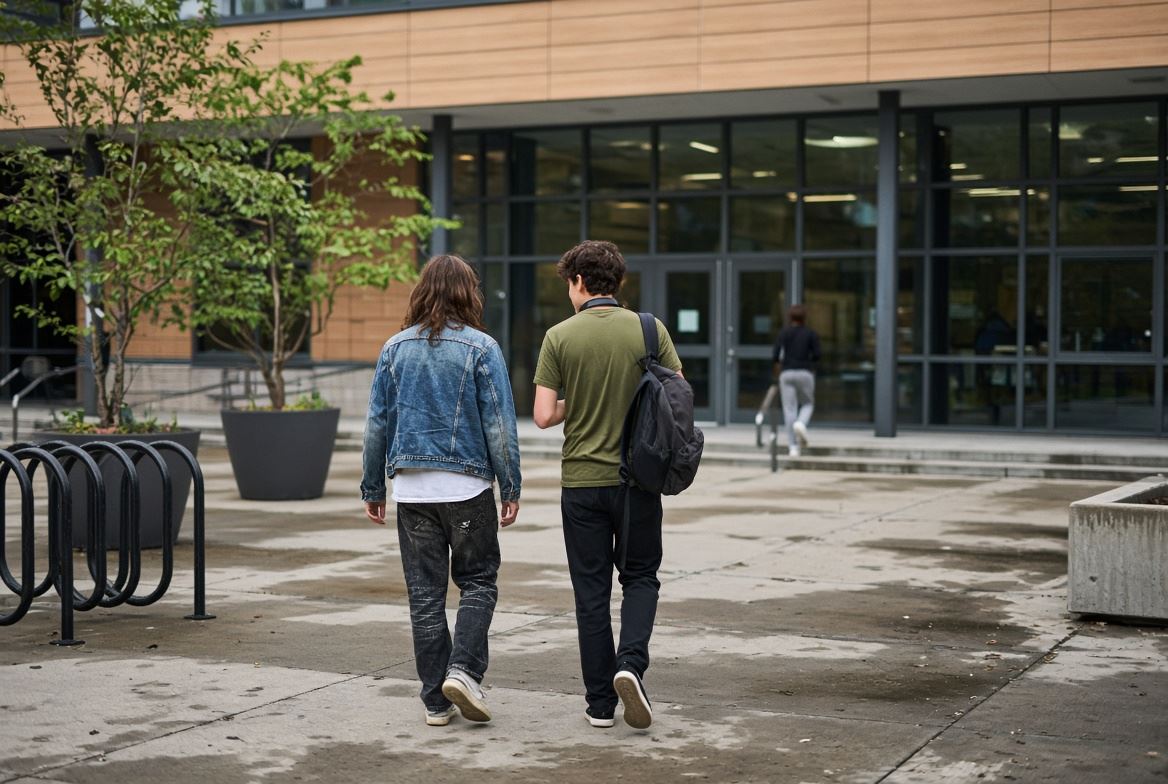
Once a family decides on an F-1 high school program in the United States, the next big question isn't academic at all: where will the student live? For international students, that answer takes one of two shapes — a boarding school, where campus is home, or a day school with a host family, where an American family's house is. The two paths can lead to the same diploma, but almost nothing about the year in between feels the same.
This guide compares them honestly — daily life, immersion, supervision, cost structure, and which kinds of schools offer which — so you can choose on fit instead of guesswork.
The two models, in one minute
A boarding school houses students on campus. Dorms, dining hall, evening study hours, weekend activities — the school runs all of it, and residential staff live where the students live. Room and board are part of the program, usually in one combined bill.
A day school with a host family means the student attends classes during the day and lives with a local American family — a homestay. Depending on the program, the homestay is arranged by the school itself, by a homestay company or receiving organization, or occasionally by the family through relatives. The student gets a bedroom, meals, and a seat at a real American dinner table; a local coordinator typically checks in through the year.
Both are established, well-traveled paths for international students. Neither is "the serious option" — the right one depends on the student.
Side by side
| Boarding school | Day school + host family | |
|---|---|---|
| Where you live | On-campus dormitory | An American family's home |
| Who runs housing | The school's residential staff | The school, a homestay company/receiving organization, or relatives |
| Evenings & weekends | Structured — study hall, campus events, dorm life | Family life — dinners, errands, local weekends |
| Peer environment | Classmates around the clock, often internationally diverse | American family at home, school friends by day |
| English immersion | High in class; dorms can cluster by language | Near-total — home life happens in English |
| Independence level | High structure, less day-to-day independence | More self-direction inside family rules |
| Typical school type | Nearly all private | Private (multi-year) or public (one year) |
| Cost shape | One bill — tuition, room & board together | Tuition + a separate homestay fee |
Daily life: a campus vs. a hometown
At a boarding school, the day has rails. Classes, sports, dinner in the dining hall, supervised study hours, lights-out — the structure is the product, and for many students it's exactly what lets them focus. Weekends bring organized trips and campus events, and there's always someone around: roommates, dorm parents, coaches.
With a host family, the rails are replaced by rhythms. You ride to school the way local kids do, come home to a family kitchen, do homework at their table, and get folded into whatever the household does — youth soccer on Saturdays, a grandmother's birthday, errands and holidays. The structure is lighter; the belonging is deeper.
Boarding school gives you a campus. A host family gives you a hometown.
Neither is universally better. A highly self-directed student can thrive on the freedom of family life; a student who wants maximum focus and built-in friends may do better inside a dorm's routine.
Language and cultural immersion
Here's the trade families don't always see coming.
Boarding schools — especially those with strong international programs — often enroll students from many countries. That's a genuine gift: a sixteen-year-old can leave with friends on four continents. The honest flip side is that dorm life can cluster by shared language, and a student who wants to can spend most evenings speaking their mother tongue.
A homestay is the opposite bargain. Home life happens in English, at native speed, about ordinary things — which is precisely how conversational fluency gets built. And cultural immersion isn't an activity on a calendar; it's Tuesday. Students who live with host families tend to come home with the idioms, the accent softened, and a second family they call on graduation day.
If rapid English growth and American family life are the goals, homestay has the edge. If a global peer network and structured community are the goals, boarding pulls ahead.
Supervision and support: ask who's responsible
This is the section to read twice, because the two models handle oversight very differently.
At a boarding school, supervision is institutional and visible: residential staff live in the dorms, the school sets the rules, and accountability is one phone number.
In a homestay program, oversight comes from the program's design — and federal rules for F-1 don't standardize it, so the organization's own standard is the standard. Good programs look similar: the host family is screened and background-checked, a local coordinator lives nearby, visits, and is the first call when something comes up, and there's a clear escalation path behind them. Before committing to any day-school program, ask three questions: Who screened the family? Who visits during the year? Who do we call at 9 p.m. in February? The quality of those answers tells you most of what you need to know — our six roles guide explains who does what behind the scenes.
What it costs — the structure, not just the number
Exact prices vary too much by school and region for one honest number, but the shape of the cost differs in a way worth understanding:
- Boarding is one consolidated bill — tuition, room, meals, and supervision together. All-in, it's usually the more expensive of the two paths, because you're paying for a residential campus that runs around the clock.
- Day school + homestay splits the cost: the school's tuition, plus a homestay fee — part of which commonly reaches the host family as a monthly stipend on F-1 programs. The combined total is often lower than boarding for a comparable school, though not always.
Whichever path you compare, insist on seeing what the number includes — meals, airport pickup, insurance, coordinator support, activity fees. Two programs quoted at the same price can be very different deals, which is why every school on the XportEdu marketplace is pushed toward itemized, current pricing rather than a single mystery figure.
Which schools offer which
The living arrangement is tangled up with school type, so the public-versus-private rules shape your options here too:
- Boarding schools are nearly all private. That means no 12-month federal limit — multi-year enrollment and the diploma track are on the table, along with postgraduate (PG) years at many prep schools.
- Day schools come in both kinds. A private day school with a homestay program supports multi-year study just like boarding does. A public day school is capped by federal law at 12 months of F-1 attendance in grades 9–12, with the district's full per-capita cost paid up front — a real option, but a one-year experience by design.
- Some day schools run their own homestay network; others partner with a homestay company or receiving organization. Both work — what matters is the screening and support behind it, per the questions above.
How to choose: five questions for your family
- How independent is the student, honestly? Structure protects some students and chafes others.
- What's the language goal? Fastest route to fluent, natural English: a home that speaks it at dinner.
- How long is the program? Multi-year diploma plans point at private schools either way; a single discovery year widens the field.
- What does the budget look like as a total? Compare all-in numbers with inclusions itemized — not sticker prices.
- What does the student picture when they imagine the year? A quad at dusk and a dorm full of friends, or a family kitchen and a hometown? That instinct counts.
Common questions
Can F-1 students live with a host family?
Yes. F-1 doesn't regulate where a student lives — homestay with a screened family, a relative's home, or a dorm are all normal. The school may have its own housing approval requirements, so confirm before finalizing plans.
Do host families get paid on F-1 programs?
Commonly, yes — F-1 homestays usually include a monthly stipend to the host family. (This is one of the clear differences from the J-1 exchange program, where host families are unpaid volunteers by federal rule.)
Is a boarding school safer than a host family?
Neither model is inherently safer — the safeguards just live in different places. Boarding schools centralize supervision on campus; good homestay programs distribute it across a screened family, a local coordinator, and the organization behind them. Judge the specific program's answers, not the category.
Can a student switch from one to the other?
Often, yes — for example moving from a one-year public day school program into a private boarding or day school for the diploma years. The F-1 school transfer process moves the student's SEVIS record to the new school; housing follows whatever the new program provides.
Which is better for getting into a U.S. university?
Universities don't prefer one housing model over the other — they read the transcript, the recommendations, and the story. Multi-year enrollment (available at private schools on either path) is what gives those materials time to grow.
The short version
Boarding school and host family homestay are both proven ways to live an F-1 high school year — one wraps the student in a structured campus community, the other in an American family and a hometown. The best choice follows the student: their independence, their language goals, their timeline, and the year they actually picture. Decide that first, and it usefully narrows which schools to look at — and if you're a family thinking about the other side of the equation, here's how hosting works.
Find the school that fits the life. The rest of the year follows from it.